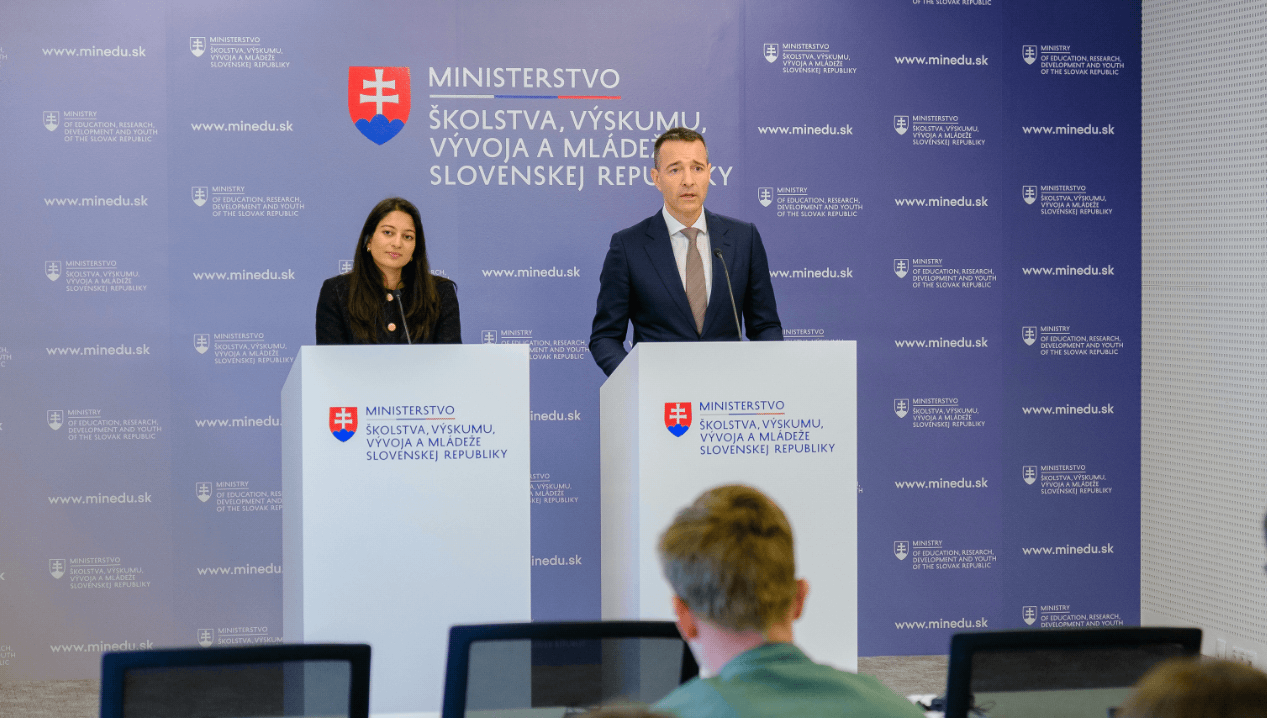

The Ministry is adding AI literacy, critical thinking and responsible AI use to the national curriculum for general secondary schools. The update now explicitly includes AI literacy, critical evaluation of AI outputs, and responsible use of digital tools as part of educational goals and the graduate profile.
The Ministry of Education, Research, Development and Youth of the Slovak Republic approved Amendment No. 6 to the national curriculum for general secondary schools. The new version will take effect on 1 September 2026. It introduces changes that move AI literacy from a marginal topic to a core part of educational goals and the graduate profile.
Responsible Use of Artificial Intelligence
The amendment expands the educational goals to include the ability to use artificial intelligence tools effectively and responsibly. Students should understand the basic principles of how AI works, use it as a personalised tool to support their own learning, and maintain critical thinking and personal identity.
The document emphasises that students should learn how to identify and analyse problems, propose solutions, and approach automated technological outputs with healthy distance and critical thinking.
The changes are also reflected in the graduate profile of general secondary school students. Graduates are now expected to understand the principles of AI, assess whether it is suitable for specific tasks, and use digital technologies, including AI, for learning and creation.
At the same time, they should critically verify AI outputs and be aware of the risks of data distortion and misinformation. The document also places strong emphasis on ethics, responsibility, and transparent acknowledgment of the extent to which AI has been used.
What Is Changing
- AI literacy becomes part of the educational goals.
- The graduate profile now includes awareness of AI risks, especially misinformation and data bias.
- Students are expected to use AI as a learning tool, not as a replacement for independent thinking.
- The amendment strengthens the focus on responsibility, ethics, and critical evaluation of digital outputs.
AI Literacy in Mathematics-Track General Secondary Schools
The topic of artificial intelligence is even more strongly reflected in mathematics-track general secondary schools. The new amendment expands their educational goals to include the systematic development of AI literacy alongside logical and critical thinking, digital literacy, and computational thinking.
Students will further develop the ability to solve complex tasks, work with argumentation and proofs, and better understand how modern AI systems function. The changes also highlight the difference between algorithmic problem-solving and machine learning systems, which rely on probability and learning from data.
The changes also respond to the needs of further study and the labour market. Graduates from mathematics-track general secondary schools should be prepared to use AI tools in data analysis, complex problem-solving, and personalised learning.
The new graduate profile expects students to assess whether AI systems are suitable for specific tasks, understand their limitations, and use them responsibly.
These competencies should help students not only in mathematics, computer science, and the natural sciences, but also in fields such as medicine, economics, social sciences, and the humanities, where data work and artificial intelligence are becoming increasingly important.
Why This Matters for General Secondary Schools
- Schools are receiving a clear signal that AI belongs in modern education.
- Students should learn to use AI practically, but also responsibly.
- Education is becoming more closely linked to critical thinking, digital safety, and personal responsibility.
- Mathematics-track general secondary schools will gain more room to explain how AI systems work in greater depth.
Part of a Broader Change in Education
By adopting this amendment, the Ministry is building on the introduction of AI literacy in primary schools. By the end of 2026, it will also gradually add the topic of artificial intelligence to vocational secondary education.
At the same time, the Ministry is preparing further updates to educational programmes, including computer science, so that they better reflect the need to teach students about artificial intelligence and its responsible use. The goal is for secondary schools to begin teaching about AI systematically from the 2027/2028 school year.
News

New Guidelines Help Younger Children Build AI Literacy and Mental Resilience

Slovakia’s TUKE and STU Launch First Joint Artificial Intelligence Degree Program