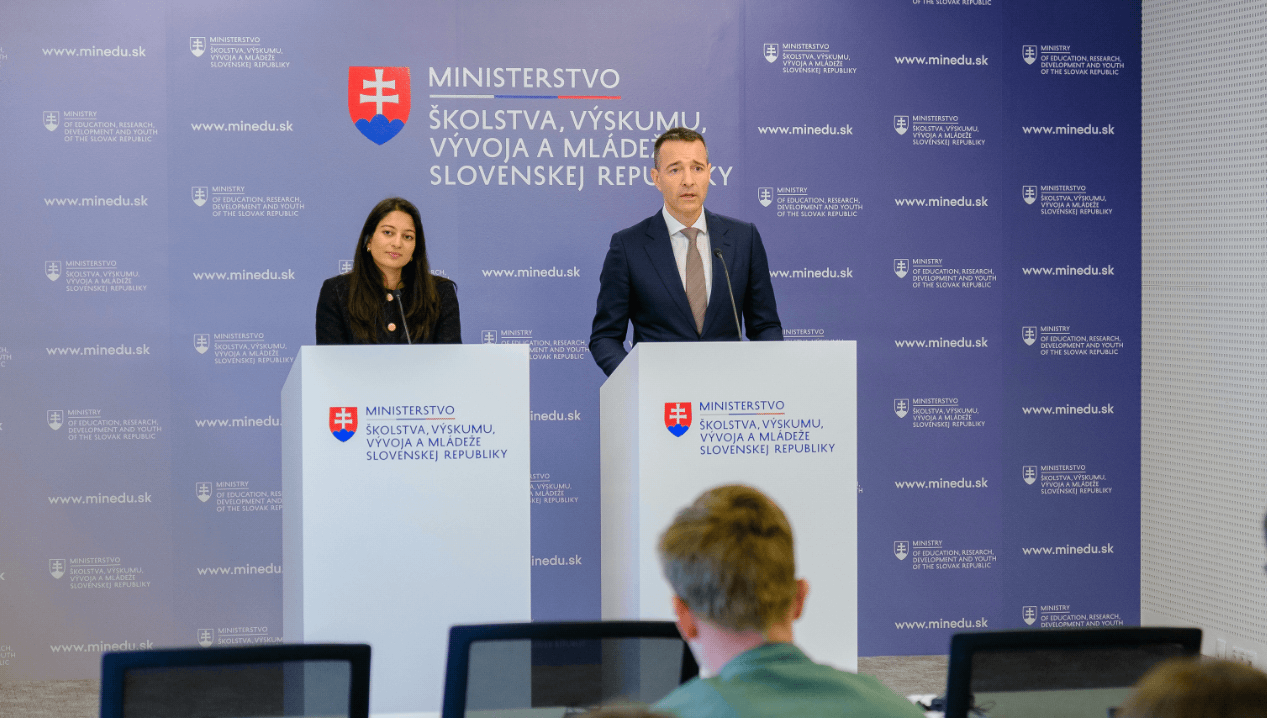

The year 2026 will mark a major step in the systematic use of artificial intelligence in Slovak schools. The Ministry of Education will build on the Plan for Responsible Use of AI in Education and gradually introduce changes in the curriculum, teacher support, methodological tools and access to practical AI solutions for schools.
To help primary and secondary schools, teachers and school leaders prepare in advance, the ministry has outlined a clear AI roadmap for 2026, structured by quarters.
Q1 2026: Foundations for systemic change
Updated national curriculum for primary schools
The Ministry of Education will publish an updated national curriculum for primary schools that expands learning content with artificial intelligence topics. AI will become part of:
- the Informatics subject,
- expanded digital and AI literacy as a cross-curricular theme,
- the development of critical thinking, data skills and technology ethics.
Students will gain a basic understanding of how artificial intelligence works, what it can and cannot do and how to use AI tools safely and responsibly in everyday learning.
National framework for digital and AI competencies for teachers
The ministry will introduce a national framework that defines the digital and AI competencies teachers need. The document will clarify the knowledge and skills educators should develop in areas such as:
- pedagogical use of AI in teaching,
- ethics, privacy and data protection,
- professional development supported by digital tools.
The framework will also create the foundation for systematic teacher training, accredited courses and stronger methodological support for schools.
AI chatbot Amos on the Učíme portal
A pilot version of the AI chatbot Amos will launch on the Učíme portal. Teachers will use it to quickly find information in the national curriculum, methodological materials and examples of good practice. The tool aims to reduce administrative workload and help teachers implement curriculum changes more easily in classrooms.
Q2 2026: Teachers and schools at the center
Launch of training courses for teachers
The ministry will begin systematic training for teachers and school specialists on the use of artificial intelligence in education. These courses will follow a modular structure, focus on practical classroom applications and remain accessible to educators across all levels of the school system.
Teachers will learn how to use AI in lesson preparation, teaching and student assessment.
National project: AI in Education
The ministry will also launch the National Project AI in Education, which will focus on:
- pilot testing of AI tools directly in schools,
- research on how AI affects teaching and learning,
- testing an AI voucher system for schools,
- targeted support for schools in less developed regions.
Support for social and emotional skills
The ministry will publish methodological materials that support empathy, active listening and conflict resolution in schools. These materials will highlight that AI should support human relationships, not replace them.
The guidance will also address healthy AI use, privacy protection and the development of healthy digital boundaries for children and young people.
Q3 2026: AI enters classrooms
Teaching about AI in primary schools
From the 2026/2027 school year, primary schools will begin teaching about artificial intelligence under the updated national curriculum. AI will become a natural part of learning across subjects rather than a standalone topic.
Implementation of EU rules for high-risk AI systems
New European Union rules for high-risk AI systems will begin to affect educational practice. Schools will strengthen their focus on transparency, safety and the protection of students’ and teachers’ rights when using digital technologies.
The European Commission proposed postponing stricter rules in November 2025, but the European Parliament has not yet approved the proposal.
Q4 2026: AI expansion in secondary education
Updated curriculum for secondary schools
The ministry will complete the update of national curricula for secondary schools to include artificial intelligence topics. Schools will move to the new curriculum from September 2027, giving them sufficient time to prepare.
Continuous methodological support
The Ministry of Education will continue to provide methodological guidance through the ai.iedu.sk portal. Schools will find updated teaching materials, practical AI tools adapted to the Slovak education system and support for teachers, school leaders and digital coordinators.
Toward a systemic transformation
The AI roadmap for 2026 shows that artificial intelligence in education is not based on isolated projects. Instead, it represents a systematic and long-term transformation that connects curriculum reform, teacher development, student learning and technological innovation.
The goal is a modern education system that uses artificial intelligence responsibly, ethically and in ways that strengthen human potential.
News

New Guidelines Help Younger Children Build AI Literacy and Mental Resilience

Slovakia’s TUKE and STU Launch First Joint Artificial Intelligence Degree Program